The Ultimate Guide to the Signpost Outline Icon: Versatility Across Every Digital Landscape
In the vast and intricate world of digital design, visual communication serves as the universal language that connects users with information. Among the myriad of symbols we encounter daily, the Signpost Outline Icon stands out as a fundamental tool for navigation, clarity, and direction. Whether you are a web developer building a complex interface, a mobile app designer focusing on user experience (UX), or a marketing professional creating a presentation, understanding the utility and technical specifications of high-quality icons is crucial. This article explores the significance of the signpost icon, its technical versatility, and why having access to the right file formats—specifically a comprehensive pack including AI, EPS, JPG, PNG, and SVG—is essential for modern creative workflows.
Understanding the Significance of the Signpost Icon
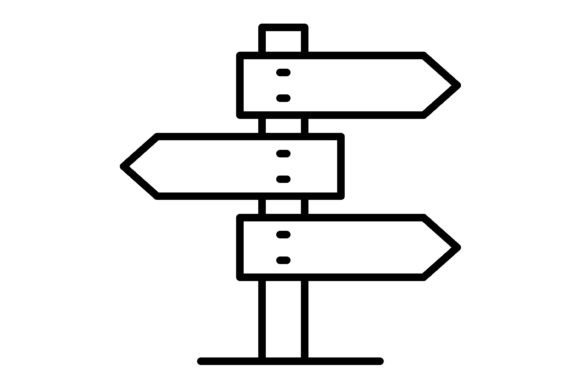
At its core, a signpost represents guidance. In the physical world, it tells travelers which way to go to reach their destination. In the digital realm, the Signpost Outline Icon serves a similar, albeit metaphorical, purpose. It is often used to denote navigation menus, location markers, directional cues, or "you are here" features within an application or website.
The design style of this particular icon—outline—is particularly significant in modern UI design. Unlike filled or solid icons, outline icons offer a minimalist aesthetic. They use thin lines and negative space, which helps to reduce visual clutter on a screen. This is especially important for mobile devices where screen real estate is limited. An outline icon allows the user to recognize the symbol without it feeling heavy or overwhelming, contributing to a cleaner, more sophisticated user interface.
Why File Formats Matter: A Technical Breakdown
When you download a resource like the Signpost Outline Icon, you are not just getting a single image; you are receiving a toolkit. The inclusion of 5 different formats—AI, EPS, JPG, PNG, and SVG—is a hallmark of a professional-grade asset. Each format serves a distinct purpose in the design and development lifecycle. Understanding these differences is key to knowing when and how to use the icon effectively.
- AI (Adobe Illustrator): This is the native file format for Adobe Illustrator. It is the "source code" of the icon. If you need to change the thickness of the lines, alter the color scheme, or merge the signpost with other shapes, the AI file is where you start. It offers infinite scalability and full editability.
- EPS (Encapsulated PostScript): Similar to AI, EPS is a vector format widely used for printing. If you are creating a business card, a brochure, or a large banner, EPS ensures the signpost icon prints with crisp, sharp edges, regardless of the size.
- JPG (Joint Photographic Experts Group): While JPGs are generally "lossy" (meaning they lose some quality when compressed), they are universally compatible. They are best used for static presentations or web pages where the icon does not need a transparent background and file size needs to be minimized.
- PNG (Portable Network Graphics): The PNG format is the workhorse of web design. Crucially, this pack includes PNGs with a Transparent Background. This allows you to place the signpost icon over any colored background, image, or pattern without an ugly white box surrounding it.
- SVG (Scalable Vector Graphics): Perhaps the most critical format for modern web and app development is SVG. Unlike JPGs and PNGs, which are made of pixels, SVGs are made of code (XML). This means they can be scaled to the size of a billboard or shrunk to the size of a watch face with zero loss of quality. They are lightweight and load incredibly fast, making them perfect for responsive websites.
Practical Applications: Where the Icon Shines
The beauty of the Signpost Outline Icon lies in its adaptability. Because it is designed with "maximum usability" in mind, it fits seamlessly into a variety of contexts. Let us explore how this asset can enhance different projects.
1. Mobile App Development
In mobile design, clarity is king. Users often navigate apps with their thumbs on small screens. The Signpost Outline Icon is suitable for mobile apps because its clean lines are legible even at small sizes. It can be used as a bottom navigation tab for "Explore," "Map," or "Guides." Furthermore, because the icon set is vector-based, developers can adjust the color dynamically—perhaps turning the icon blue when selected and gray when inactive—without needing multiple image files.
2. Website Design and User Experience
For websites, the SVG format is indispensable. A web developer can embed the Signpost Outline Icon directly into the HTML code. This allows the icon to inherit CSS styles, such as hover effects or animations. Imagine a user hovering over a "Get Directions" button, and the signpost icon subtly spins or changes color. This level of interactivity is only possible with vector formats like SVG, making the icon a powerful tool for engaging website visitors.
3. Print and Presentations
While digital use is prevalent, the need for print materials remains strong. The EPS and AI files ensure that if you decide to use the signpost icon on a conference poster or a business presentation, it will look professional. Pixelation (the jagged edges seen when an image is enlarged too much) is a common mistake made by non-designers. By using the vector files included in this pack, you guarantee that your materials look polished and high-resolution.
4. Illustration and Templates
For content creators and illustrators, this icon set acts as a building block. You might be designing a travel blog template or an infographic about career paths. The signpost icon can be customized to fit the specific aesthetic of your template. Because the icons are easy to edit and scale, you can create complex illustrations by combining the signpost with other elements like roads, maps, or text boxes.
Design Principles: Usability and Aesthetics
The prompt notes that "Each Line icon is designed for maximum usability." What does this mean in practice? It refers to the adherence to grid systems and pixel perfection.
Professional icon designers do not simply draw a shape; they construct it within a grid (often a 24x24 or 32x32 pixel grid). This ensures that when the icon is displayed on a digital screen, the lines align perfectly with the pixels on the monitor, resulting in a sharp image. If an icon is not pixel-perfect, it can appear blurry, even if it is technically a vector. The Signpost Outline Icon has been crafted to avoid this issue, ensuring it looks crisp on both high-resolution Retina displays and standard screens.
The Psychology of Navigation
From a psychological standpoint, using a signpost icon helps reduce cognitive load. When a user sees a familiar symbol, their brain processes it much faster than reading text. By incorporating this icon into your design, you are helping users navigate your content more intuitively. It signals "movement" and "decision," encouraging the user to take the next step in their journey, whether that is clicking a link, downloading an app, or following a set of instructions.
Integrating the Icon into Your Workflow
Adopting a new icon set should be a smooth process. Here is a step-by-step approach to integrating the Signpost Outline Icon into your current projects:
- Assess Your Platform: Are you working on a mobile app, a website, or a print document? Choose the file format that matches your medium (SVG/PNG for web/app, EPS/AI for print).
- Check for Consistency: If you are adding this signpost to an existing set of icons, ensure the line weight (thickness) matches. If the new icon is thicker or thinner than your others, use the AI or SVG file to adjust the stroke width.
- Optimize for Performance: If using SVGs for the web, ensure the code is minified to reduce file size. If using PNGs, compress them to ensure fast page load times.
- Test for Accessibility: Ensure the icon has enough contrast against its background. An outline icon can sometimes be hard to see if placed on a busy background. Adding a subtle drop shadow or a solid circle behind the icon can help.
Conclusion: A Small Asset with Big Impact
In the grand scheme of a digital project, an icon might seem like a small detail. However, the Signpost Outline Icon is a testament to how vital these details are. It bridges the gap between the user and the interface, providing direction in a chaotic digital world.
With the inclusion of 100 vector icons in this pack, you are not just getting a single image; you are gaining a comprehensive design system. The variety of formats—AI, EPS, JPG, PNG, and SVG—ensures that no matter what device, platform, or medium you are working with, you have the right tool for the job. By prioritizing usability, scalability, and editability, this icon set empowers designers and developers to create better, more intuitive digital experiences.
Whether you are building the next great mobile app, refreshing a corporate website, or designing an educational presentation, the signpost icon is your guide to professional and effective visual communication. We hope this guide has illuminated the potential of this versatile asset and that you find it as useful in practice as it is in theory.