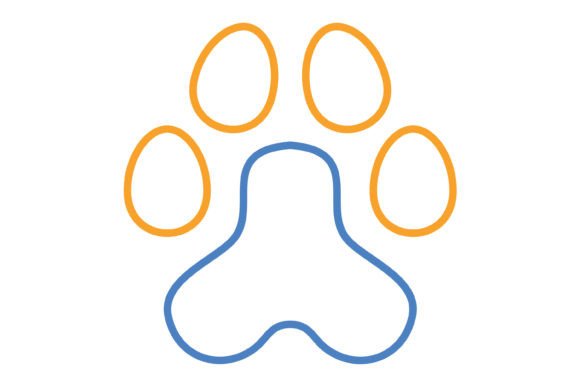
The Ultimate Guide to the Paw Print Blue Orange Line Icon Set: Versatility, Formats, and Design Excellence
In the vast world of digital design, icons serve as the silent ambassadors of user experience. They guide our eyes, simplify complex ideas, and add personality to otherwise sterile interfaces. For designers, pet lovers, veterinarians, and animal-focused businesses, finding the perfect iconography can be a challenge. This is where the Paw Print Blue Orange Line Icon set distinguishes itself. More than just a simple graphic, this collection represents a blend of aesthetic appeal and technical precision, designed to meet the rigorous demands of modern digital and print environments.
This article explores the depth of this specific icon set, examining why its design choices matter, how its included file formats solve real-world workflow problems, and how its versatility makes it a valuable asset for everything from mobile app development to professional presentations.
Understanding the Aesthetic: Why Blue and Orange?
Color psychology plays a crucial role in design. The choice of blue and orange in this paw print icon is not merely stylistic; it is strategic. Blue is universally associated with trust, stability, and calmness. In the context of a paw print, it suggests reliability—perfect for veterinary clinics, pet insurance companies, or adoption agencies looking to project an image of care and professionalism.
Conversely, Orange represents energy, enthusiasm, and warmth. It evokes the playful nature of animals. When combined, these colors create a dynamic visual contrast that grabs attention without being overwhelming. The "Line Icon" style ensures that the design remains modern and clean. Unlike heavy, filled icons, line art offers a minimalist feel that fits seamlessly into contemporary UI/UX design trends, ensuring the icon does not clutter the visual hierarchy of your project.
A Deep Dive into the File Formats Included
One of the most significant technical advantages of this icon set is the variety of file formats included in the zip file. Different projects require different data structures. By providing five distinct formats, the creators ensure that designers and developers are never stuck trying to convert files or losing quality in the process.
1. AI (Adobe Illustrator)
The AI format is the native file type for Adobe Illustrator, the industry standard for vector graphics. This file is the "master" source. It contains all the editable paths, layers, and anchor points. If you need to change the thickness of the paw lines, alter the specific shade of blue, or combine this paw print with other vector shapes, the AI file is your starting point. It is essential for professional graphic designers who need full control over the creative process.
2. EPS (Encapsulated PostScript)
EPS is a legacy vector format that remains a powerhouse in the print industry. While AI files are specific to Adobe, EPS files can be opened by a wide range of vector software, including CorelDRAW, Inkscape, and older versions of design programs. If you are sending the icon to a print shop for large-format printing—such as a banner for a pet adoption event—EPS is often the safest format to ensure the printer renders the lines perfectly without pixelation.
3. SVG (Scalable Vector Graphics)
For the modern web developer, SVG is arguably the most important format. SVGs are written in XML code, meaning they are lightweight and can be manipulated via CSS and JavaScript. This format is listed as "Suitable for Mobile Apps, Websites" because SVGs scale infinitely without losing quality and load incredibly fast. You can change the color of the paw print from blue to red simply by changing a line of code, making it ideal for responsive web design.
4. JPG (Joint Photographic Experts Group)
The JPG format is included for universal compatibility. While it is not scalable like vectors, it is the standard for quick viewing, email attachments, and older content management systems. This format is optimized for web use, balancing quality with file size, ensuring your website or email newsletter loads quickly for users with slower internet connections.
5. PNG (Transparent Background)
The PNG format is the workhorse for digital content creators. The critical feature here is the Transparent Background. This allows you to place the paw print icon over any colored background, photograph, or pattern without having an ugly white box surrounding it. Whether you are placing the icon on a dark slide in a PowerPoint presentation or overlaying it on a video, the PNG format ensures seamless integration.
Practical Applications: Where Design Meets Function
The true value of a design asset lies in its usability. The description notes that this set is "Ready to use for all devices and platforms." Let’s break down what that looks like in practice.
Mobile Applications
In mobile app development, screen real estate is precious. Icons must be legible at very small sizes. Because this icon set features 100 vector icons designed for "maximum usability," developers can use them for navigation bars, tab bars, and loading screens. The crisp lines ensure that the paw print remains recognizable even on the smallest smartphone screens.
Websites and Digital Media
Web designers often struggle with asset consistency. Using this set ensures that your website maintains a cohesive look. The "Line Icon" style is particularly effective for "call to action" buttons or feature lists. For example, a pet grooming website could use the paw print icon next to a "Book Now" button to reinforce the brand identity subconsciously.
Print and Presentation
Despite the digital age, print is far from dead. The "Easy to edit and scale" feature is vital here. You can scale the vector icons to the size of a billboard or shrink them down for a business card without any loss of resolution. Furthermore, in presentations, visual aids help retention. Using a consistent set of professional icons, rather than generic clipart, elevates the perceived value of your business pitch or educational seminar.
The Importance of "100 Vector Icons"
The mention of 100 vector icons suggests this is not just a single image, but a comprehensive library. In design, consistency is key. If you use a specific style of paw print on your homepage, you need matching icons for "Search," "Home," "Profile," and "Settings" to maintain a professional look.
Having a library of 100 icons allows for creative storytelling. You can create a full ecosystem of graphics for a pet-themed project. This quantity ensures that designers have options, allowing them to select the perfect variation of the paw print—perhaps one facing left, one facing right, or one with a heart in the center—to fit the specific context of their layout.
Overcoming Common Design Misunderstandings
A common misconception among beginners is that a "line icon" is inferior to a detailed illustration. However, in the context of modern UI/UX, simplicity is a feature, not a bug. Detailed illustrations can distract users from content. Line icons act as visual cues that speed up navigation. They are designed for maximum usability, meaning they prioritize clarity and speed of recognition over artistic complexity.
Another misunderstanding involves file formats. Many users download a zip file and only look for the JPG, ignoring the AI or EPS files. By understanding the technical benefits of each format—as outlined above—users can leverage the full power of the asset pack, ensuring their designs look professional across all mediums.
Conclusion: A Tool for Creative Excellence
The Paw Print Blue Orange Line Icon set is more than just a collection of graphics; it is a versatile toolkit for communication. By combining a psychologically effective color palette with a robust selection of industry-standard file formats, it bridges the gap between creative vision and technical execution.
Whether you are a developer building the next great pet social network, a teacher creating an engaging biology lesson, or a business owner designing marketing materials, the features of this set—scalability, transparency, and cross-platform readiness—ensure that your work stands out. It is a reminder that good design is not just about how things look, but how well they work.